Posts by Collection

portfolio

Stress Controller

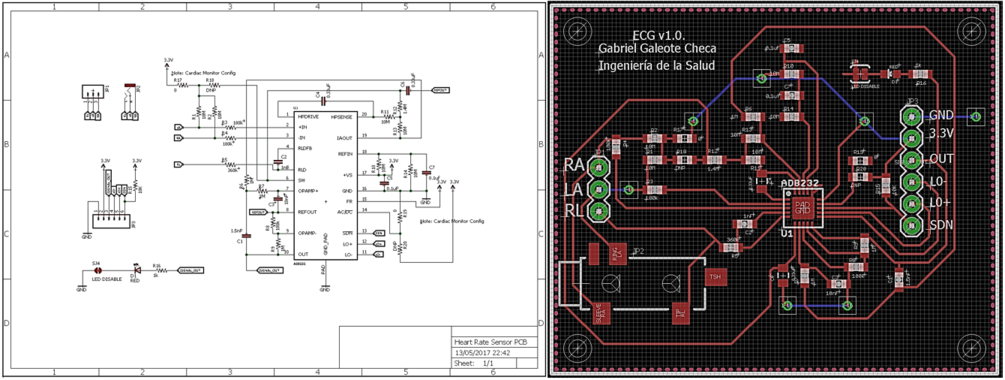
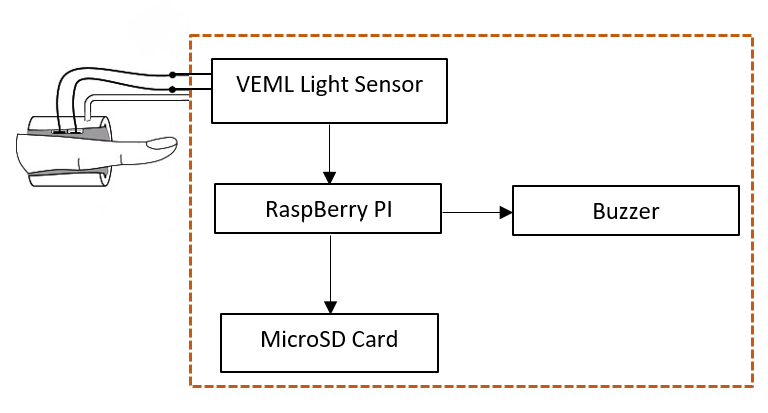
Real-Time embedded system using an ATMega and VEML3060 sensor to monitor the stress level of patients with anger control difficulties

Brain Implantable Device

Brain Implantable Device fabricated using Polymide Dupont Pyralux AP8535R and powered using Wireless Power Transmission for wireless power and communication. Device encapsulated with biocompatible material.

publications

A review of Quantum Dots methods and their applications in the field of Biotechnology

Published in Educational Innovation Project of University of Malaga Conference Days , 2016

The purpose of this communication is to make a bibliographic review of Quantum Dots methods and their applications in the field of Biotechnology. Quantum dots (QDs) are a novel class of inorganic fluorophores, which are gaining widespread recognition as a result of their exceptional photophysical properties.

Ciborg: Analisis actual y futuras consecuencias

Published in Ariel-Revista de filosofía, 22, 23-29, 2018

The progress in human enhancement technology is a key factor in the human history. Its main development is leaded by biohacker communities that drives this technological revolution with projects worthy of science fiction

Flexible Wirelessly Powered Implantable Device

Published in 26th IEEE International Conference on Electronics, Circuits and Systems (ICECS), 2019

This paper presents a neural implant that is powered wirelessly using a flexible biocompatible antenna. We have applied a modular structure approach to the design of this device considering three modules of antenna, conditioner circuit and shank. The implant was fabricated using a flexible substrate of Polyimide and encapsulated by PDMS for chronic implantation. In addition, finite element method COMSOL Multiphysics simulation of mechanical forces acting on the implant and shank was carried out to validate a viable shank conformation-encapsulation combination that will safely work under operational stress with a satisfactory margin of safety.

Wirelessly Powered and Modular Flexible Implantable Device

Published in 2020 27th IEEE International Conference on Electronics, Circuits and Systems (ICECS), 2020

This paper introduces a novel configuration for a wirelessly powered and modular implantable device, fabricated using flexible electronics. The neural implant, which is based on Wireless Power Transfer, comprises a receiver antenna, a power management circuit, and a shank for power transmission, recording, and stimulation.

The Future of Neuroscience: Flexible and Wireless Implantable Neural Electronics

Published in Advanced Science, 2021

This paper presents challenges in engineering and neuroscience in developing miniaturized and biointegrated alternatives, in the form of microelectrode probes. Progress in design and topology of neural implants has shifted the goal post toward highly specific recording and stimulation, targeting small groups of neurons and reducing the foreign body response with biomimetic design principles. Implantable device design recommendations, fabrication techniques, and clinical evaluation of the impact flexible, integrated probes will have on the treatment of neurological disorders are provided in this report.

Baseline Features Extraction from Microelectrode Array Recordings in an in vitro model of Acute Seizures using Digital Signal Processing for Electronic Implementation

Published in 2021 IEEE International Conference on Omni-Layer Intelligent Systems (COINS), 2021

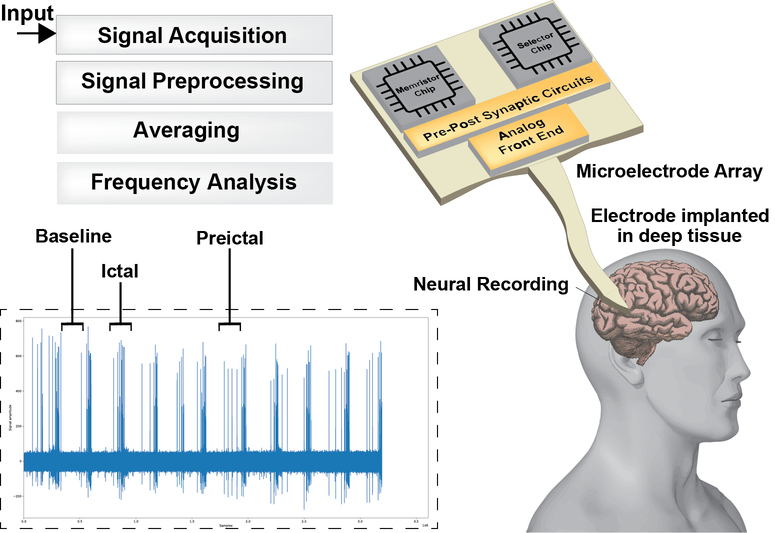
Microelectrode arrays (MEA) arise as a promising technology enabling detection of local field potentials from multiple locations and permitting the acquisition of more information on brain network electrical activity than conventional electrophysiology techniques. However, whereas most of the electrophysiological studies addressing brain activity have focused on events/patterns analysis, no one has so far addressed the features that might be hidden within the signal baseline. In this paper, I performed an analysis of the Microelectrode Array Signal to study all the features and frequency content of this signal.

Time series segmentation for recognition of epileptiform patterns recorded via microelectrode arrays in vitro

Published in Plos one, 20(1), e0309550, 2025

Researchers have addressed the challenge of detecting and classifying events from ongoing brain activity with computationally inexpensive implementations by developing two algorithms: ZdensityRODE and AMPDE. These algorithms utilize time series segmentation (TSS) to extract different levels of information from LFPs and identify relevant events.

Real-Time Seizure Detection in Microelectrode Array based on Z-Test Spike Detection for Hardware Implementation

Published in 2025 IEEE International Symposium on Circuits and Systems (ISCAS), 2025

A proposed approach combines a Z-test-based spike detection algorithm with a heuristic decision tree to differentiate between interictal and ictal events. This algorithm operates in real-time to segment local field potentials (LFP) recorded via microelectrode arrays (MEA), aiming for minimal latency and low power requirements in detecting seizure onsets.

talks